
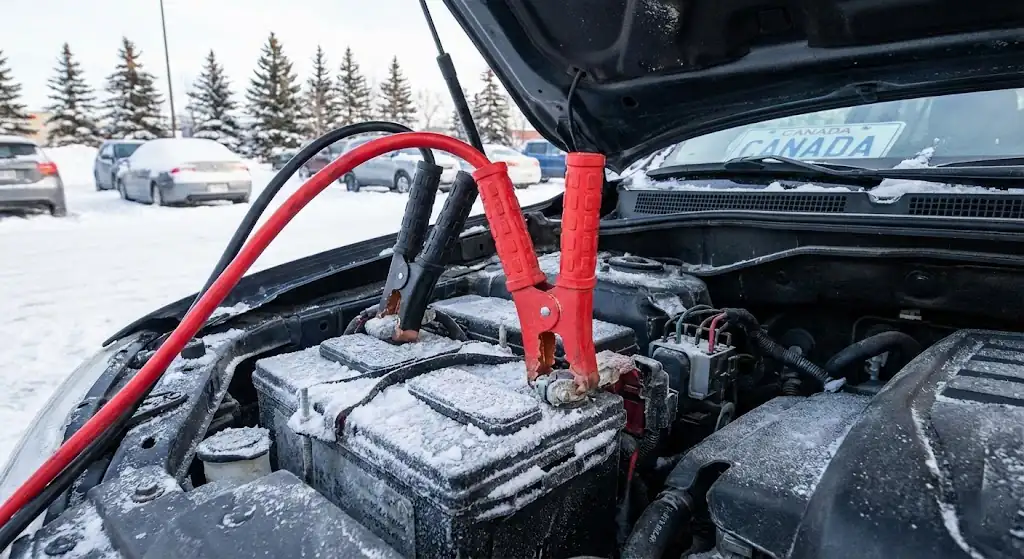
How to Jump Start a Car: Complete Safety Guide for Montreal Drivers
You turn the key and hear nothing but a weak clicking sound. The dashboard flickers. The engine will not crank. A dead battery is one of the most common breakdowns in Montreal — and knowing how to jump start a car safely is a skill every driver should have. Whether you are using jumper cables with a second vehicle or a portable battery booster pack, this guide walks you through the exact cable connection order, critical safety rules, common mistakes that damage electronics, and when a jump start is not enough and you need professional help.
⚡ Quick Cable Order
RED (+) → Dead battery positive terminal
RED (+) → Good battery positive terminal
BLACK (−) → Good battery negative terminal
BLACK (−) → Unpainted metal bolt on dead car’s engine block (NOT the battery)
Don’t want to DIY? Call (514) 483-6944 for 24/7 battery boost service in Montreal.
Before You Jump Start: Safety Checks You Must Not Skip
A car jump start involves connecting two batteries and pushing hundreds of amps through cables. Done correctly, it is perfectly safe. Done wrong, it can cause electrical damage, acid burns, or a battery explosion. Complete these checks first:
⚡ Rule 1: Inspect the dead battery visually. If you see cracks, leaking fluid, swelling, or a rotten-egg sulfur smell, do not attempt a jump start. The battery may be damaged and could explode. Call a professional instead.
⚡ Rule 2: Make sure both vehicles are turned off with keys removed before connecting any cables. Both vehicles must be in Park (automatic) or Neutral (manual) with the parking brake engaged.
⚡ Rule 3: Remove any jewelry, watches, or metal bracelets. Metal items contacting both battery terminals simultaneously can cause a short circuit and severe burns.
⚡ Rule 4: Keep the clamp ends from touching each other or any metal surface while connected to a battery. Red and black clamps contacting each other creates a dangerous short circuit with visible sparking.
⚡ Rule 5: Check that both vehicles use the same voltage system. Nearly all passenger cars are 12V. Do not attempt to jump a 6V or 24V vehicle (some vintage cars, heavy trucks) with a standard 12V car — it will cause damage.
If any of these checks raise a concern, skip the DIY and call Montreal Towing at (514) 483-6944. Our technicians carry professional-grade battery diagnostic equipment and boosters that handle every situation safely.
How to Jump Start a Car With Jumper Cables: Step-by-Step
This is the standard method using a second running vehicle and a set of jumper cables. Follow the cable connection order exactly — getting it wrong can fry your car’s electronics.
Position the vehicles. Park the working car close enough that cables can reach both batteries — typically nose-to-nose or side-by-side. The vehicles should not be touching each other. Turn off both engines, remove keys, and engage parking brakes.
Connect RED (+) clamp to the dead battery’s positive terminal. The positive terminal is marked with a + sign and usually has a red cap or wire. Clamp firmly onto the terminal post — not the cable attached to it.
Connect the other RED (+) clamp to the good battery’s positive terminal. Walk the cable to the working vehicle and clamp onto its positive terminal.
Connect BLACK (−) clamp to the good battery’s negative terminal. The negative terminal is marked with a − sign and usually has a black cap or wire.
Connect the last BLACK (−) clamp to an unpainted metal bolt on the dead car’s engine block. This is the grounding point — a bare metal bracket, engine bolt, or strut tower. Do NOT connect it to the dead battery’s negative terminal. This prevents sparks near the battery where hydrogen gas may be present.
Start the working vehicle. Let it idle for 2–3 minutes. This charges the dead battery enough to attempt a start. For severely drained batteries, wait 5 minutes.
Start the dead vehicle. Turn the key or push the start button. If it cranks slowly, wait another minute and try again. Do not crank continuously for more than 10 seconds — this overheats the starter motor.
Remove cables in REVERSE order. Black from engine block → Black from good battery → Red from good battery → Red from dead battery. Keep the revived car running for at least 20–30 minutes to recharge the battery.
⚠️ Critical: If the jump start does not work after 3 attempts, stop trying. Repeated cranking with cables connected can damage the alternator, ECU, or other electronics in both vehicles. The battery may be completely dead and need replacement, or the problem may not be the battery at all.
How to Jump Start a Car With a Portable Battery Booster
Portable lithium-ion jump starter packs have become one of the most popular car accessories — and for good reason. They are compact, powerful, and you do not need a second vehicle. Here is how to use one for a car jump start:
1. Make sure the jump starter is charged (most have LED indicators). A fully charged unit should provide 2–4 starts.
2. Turn off the vehicle and all accessories. Connect the red clamp to positive (+) and the black clamp to an unpainted metal ground point (same as with cables).
3. Turn on the jump starter unit. Most have an activation button or switch.
4. Start the vehicle. If it does not start within 5 seconds, wait 30 seconds and try again. Maximum 3 attempts.
5. Remove clamps (black first, then red). Let the car run for 20–30 minutes. Recharge the jump starter pack when you get home.
💡 Montreal Winter Tip: Lithium-ion jump starters lose capacity in extreme cold. If yours has been sitting in a −20°C trunk all night, warm it inside the cabin for 10–15 minutes before using it. Keep it in your winter emergency kit but move it indoors during the coldest months.
7 Common Jump Start Mistakes That Damage Your Car
These errors range from mildly wasteful to genuinely dangerous. Avoid every one of them:
❌ Connecting cables in the wrong order. Reversing polarity (red to negative, black to positive) can instantly fry the ECU, alternator, fuses, and other electronics. Repair costs: $500–$3,000+.
❌ Grounding the last cable directly to the dead battery. Batteries emit hydrogen gas, which is highly flammable. A spark at the terminal can ignite the gas, causing the battery to explode and spray sulfuric acid.
❌ Using thin or damaged jumper cables. Cheap, thin cables cannot handle the amperage needed to start a car. They overheat, melt, and deliver insufficient power. Use 4-gauge or heavier cables rated for at least 400 amps.
❌ Revving the donor car’s engine to “give more power.” This sends voltage spikes through the cables that can damage the sensitive electronics in modern vehicles. Keep the donor car at a steady idle.
❌ Turning off the car immediately after a successful start. A recently dead battery needs at least 20–30 minutes of driving to rebuild enough charge to restart. Turning off too soon means you will need another jump start.
❌ Ignoring repeated dead batteries. If your battery dies more than once in a short period, the battery itself or the alternator may be failing. A jump start only masks the problem temporarily.
❌ Trying to jump start a hybrid or EV using another car. Many hybrid and electric vehicles have specific jump-start procedures and using the wrong method can damage the high-voltage system. Always consult your owner’s manual first.
No Cables? No Second Car? No Problem.
Professional battery boost — we arrive fast, test your battery, and get you started.
(514) 483-6944
When a Jump Start Will Not Work (And What to Do Instead)
A jump start only works if the battery has enough internal capacity to hold a charge temporarily. Here are the situations where jumping will not help:
In any of these cases, you likely need a breakdown tow to a mechanic or dealership. If the problem is just an old battery, many roadside services can install a new battery on-site. Our technicians at Montreal Towing carry testing equipment that distinguishes between a dead battery, a failing alternator, and a parasitic drain — so you know exactly what you are dealing with before spending money.
Why Dead Batteries Are So Common in Montreal
Montreal’s climate is one of the hardest environments in North America for car batteries. Here is why jump start calls spike every year:
Extreme cold reduces battery capacity. At −20°C, a car battery retains only about 50% of its starting power. At −30°C, that drops even further. A battery that barely started your car in October may fail completely in January.
Short trips prevent full charging. If you only drive short distances, the alternator never fully recharges the battery. Over time, the charge deficit accumulates until the battery cannot start the car. This is especially common for Montreal commuters with 15-minute drives.
Parasitic drain from modern electronics. Keyless entry systems, dashcams, alarm systems, and infotainment computers draw small amounts of power even when the car is off. In cold weather, this drain depletes a weakened battery faster.
Heat damage from summer. Ironically, summer heat does more internal damage to batteries than winter cold. High temperatures accelerate chemical degradation inside the battery. The damage shows up months later when cold weather demands maximum performance from an already weakened unit.
Average battery life is shorter in Montreal. While batteries are rated for 4–5 years, the CAA Quebec has noted that Montreal’s harsh conditions often reduce actual lifespan to 3–4 years. If your battery is over 3 years old, have it tested before winter arrives.
Jump Start Cost: DIY vs Professional vs Replacement
Here is what each option costs in the Montreal area:
For full pricing across all roadside services, see our complete towing costs guide for Montreal. If you have roadside assistance coverage on your auto insurance, the boost may be covered — check our insurance towing guide for details.
How to Prevent Dead Batteries in Montreal
Prevention is always cheaper than a roadside emergency. Follow these tips to keep your battery healthy year-round:
🔋 Battery Health Checklist
☐ Have your battery tested before winter — most auto parts stores do this free
☐ Replace batteries older than 3–4 years in Montreal’s climate
☐ Keep terminals clean — corrosion (white/green buildup) prevents proper contact
☐ Take at least one 20+ minute drive per week to let the alternator fully charge
☐ Turn off all lights and accessories before exiting the vehicle
☐ Disconnect dashcams if parking for more than a few days
☐ Consider a winter preparedness routine including battery checks
☐ Use a battery tender / trickle charger if your car sits for extended periods
☐ Keep a portable jump starter in your winter emergency kit
☐ Save (514) 483-6944 in your contacts for battery emergencies
Related Roadside Services in Montreal
Dead batteries are just one reason drivers get stranded. Montreal Towing provides a full range of roadside assistance services, available 24/7:
🛞 Tire change — Flat tire and dead battery at the same time? It happens more than you think.
🔑 Car unlocking — Locked out with your keys inside? We open it without damage.
⛽ Fuel delivery — Ran out of gas? We bring fuel directly to your location.
🚛 Flatbed towing — When the problem is more than a dead battery and the car needs to go to a shop.
We serve all Montreal neighbourhoods including Plateau, Verdun, Old Montreal, and the entire service area.
Frequently Asked Questions: Jumping a Car Battery
What is the correct order for connecting jumper cables?
Connect in this order: Red clamp to dead battery positive (+), Red clamp to good battery positive (+), Black clamp to good battery negative (−), Black clamp to an unpainted metal ground point on the dead car’s engine. Remove in the exact reverse order. Never connect the last black cable directly to the dead battery.
Can jump starting damage my car’s electronics?
If done correctly, no. However, reversing the cable polarity, revving the donor car during the jump, or using damaged cables can send voltage spikes that fry the ECU, alternator, fuses, and other sensitive components. Modern vehicles have more electronics at risk than older models, so following the correct procedure is essential.
How long should I drive after a jump start?
Drive for at least 20 to 30 minutes at normal speed to allow the alternator to recharge the battery. Highway driving is more effective than idling because the alternator produces more current at higher RPMs. If possible, avoid using heavy electrical loads like the heated seats and high-beam headlights during this recharging period.
How much does a professional battery boost cost in Montreal?
A professional mobile battery boost in Montreal starts at $99. This includes the technician’s travel to your location, battery diagnostic testing, the boost itself, and basic charging system assessment. If the battery needs replacement, the technician can advise on next steps.
Can I jump start a car in the rain?
Yes. The voltage in a 12V car battery is not high enough to be dangerous in wet conditions. However, water on battery terminals can reduce contact quality. Wipe terminals dry before connecting clamps, and make sure clamp connections are firm. Standing water on the ground is not a risk with a 12V system.
Why does my car battery keep dying?
Common causes include a battery past its useful life (3–5 years), a failing alternator that does not recharge properly, a parasitic electrical drain from an aftermarket accessory, corroded terminals preventing full charge, or short trips that never allow the battery to fully recharge. A mechanic can test the battery and charging system to identify the exact issue.
Can I jump start an automatic car by pushing it?
No. Push-starting (bump-starting) only works on manual transmission vehicles. Automatic transmissions cannot transfer momentum from the wheels to the engine in the way required for a push start. For an automatic with a dead battery, you must use jumper cables, a portable booster, or a professional service.
Is it safe to jump start a hybrid or electric vehicle?
Most hybrids have a separate 12V battery for starting that can be jump-started using the same procedure. However, you should never use a hybrid’s high-voltage battery pack as the donor. Fully electric vehicles have specific procedures that vary by manufacturer. Always consult your owner’s manual or call a professional before attempting to jump start any hybrid or EV.
What type of portable jump starter should I buy?
Look for a lithium-ion unit rated for at least 800 peak amps for 4-cylinder cars or 1,000+ amps for 6-cylinder and larger engines. Features to prioritize: USB charging ports, built-in flashlight, reverse-polarity protection, and cold-weather rating. Top brands include NOCO, Antigravity, and Schumacher. Expect to pay $60 to $150 for a quality unit.
Where can I get a battery boost near me in Montreal right now?
Call Montreal Towing at (514) 483-6944 for immediate battery boost service anywhere in Montreal, 24 hours a day, 7 days a week. Our technician arrives with professional-grade equipment, tests your battery, performs the boost, and verifies your charging system is working properly before leaving.
Dead Battery? We Bring the Power to You.
Professional battery boost + diagnostic testing, anywhere in Montreal.
24/7 dispatch. Fast arrival. No cables needed — we handle everything.
(514) 483-6944