
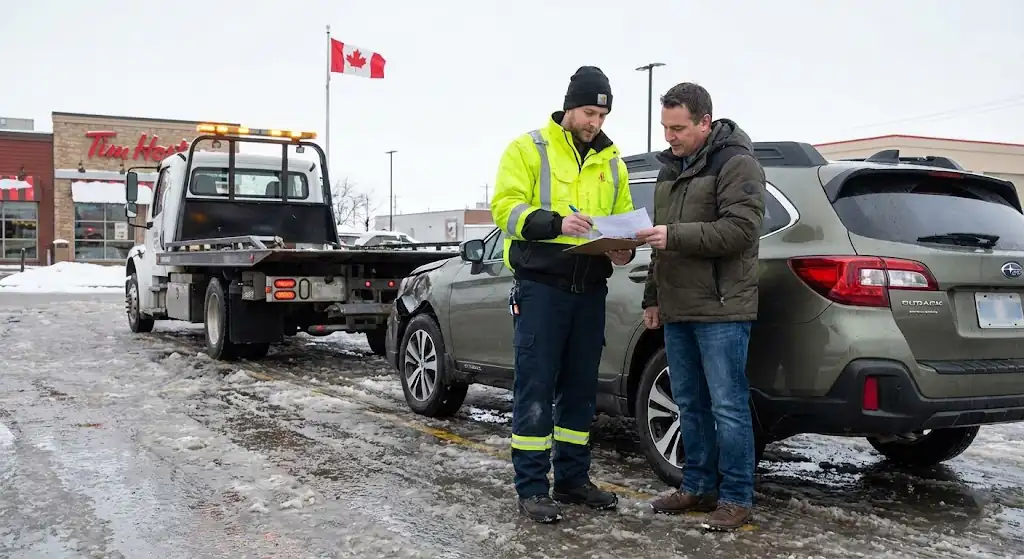
Does Auto Insurance Cover Towing in Quebec? What Drivers Need to Know
Your car just died on Boulevard René-Lévesque and a tow truck is on its way. The first question that crosses your mind: will my insurance pay for this? For most Montreal drivers, insurance towing is one of the least understood parts of their auto policy. Some assume everything is covered. Others pay out of pocket when they did not have to. This guide explains exactly what Quebec auto insurance covers when it comes to towing, how to make a claim, and how to avoid surprise bills — whether you are dealing with an accident, a breakdown, or a roadside emergency.
⚡ Quick Answer
Yes — accident towing is almost always covered by Quebec auto insurance under the Direct Compensation Agreement. Breakdown towing and roadside assistance coverage depend on your specific policy and optional endorsements.
At Montreal Towing, we bill your insurer directly — no upfront payment, certified receipts, and full claims documentation included.
Call (514) 483-6944 for insurance towing — 24/7 dispatch.
How Auto Insurance Works in Quebec: The Basics
Before diving into insurance towing specifics, it helps to understand how Quebec’s system differs from the rest of Canada. Quebec operates a unique split insurance model:
Towing falls under the vehicle damage side — meaning it is handled by your private insurer, not the SAAQ. What exactly is covered depends on your policy, the type of incident, and whether you have optional endorsements like roadside assistance or comprehensive coverage.
When Is Towing Covered by Insurance in Quebec?
The answer depends on why you need a tow. Here is a clear breakdown of the most common scenarios:
💡 Key Takeaway: If your tow is the result of an accident with another vehicle, it is almost certainly covered. If it is a breakdown or mechanical failure, coverage depends on whether you purchased optional roadside assistance. Always check your policy or call your insurer before assuming.
The Direct Compensation Agreement: How Accident Towing Gets Paid
Quebec’s Direct Compensation Agreement (DCA) is the mechanism that makes insurance towing after an accident straightforward. Under the DCA, if your vehicle is damaged in a collision with another vehicle on a Quebec public road, your own insurance company compensates you — regardless of who caused the accident.
This means you do not have to chase the other driver’s insurer for towing reimbursement. Your insurer pays directly for:
Towing from the accident scene to your chosen repair shop or storage yard
Debris cleanup and road safety restoration at the scene
Secure vehicle storage while awaiting inspection or repairs
Winching or recovery if your vehicle rolled or left the roadway
Fault is determined later using the GAA (Groupement des assureurs automobiles) Driver’s Fault Chart based on your Joint Report or police report. Even if you are found at fault, towing is still covered — though you may face a deductible and potential premium increase. For more on the full accident process, read our step-by-step car accident guide for Montreal.
The Roadside Assistance Endorsement: Coverage for Breakdowns
Standard Quebec auto insurance does not automatically cover towing for mechanical breakdowns, dead batteries, flat tires, or lockouts. For these non-collision situations, you need the roadside assistance endorsement — an optional add-on offered by most Quebec insurers.
What Roadside Assistance Typically Covers
⚠️ Important: Roadside assistance endorsements typically have an annual limit on the number of service calls (often 3–4 per year) and a dollar cap per event. If your tow exceeds the cap, you pay the difference. Always review your policy limits before you need them.
Even without the roadside endorsement, you can always call Montreal Towing directly for fast, affordable breakdown towing, battery boosts, tire changes, or car unlocking — no membership or endorsement required.
How Direct Insurance Billing Works (Pay Nothing Upfront)
One of the biggest advantages of working with an insurance towing provider like Montreal Towing is direct billing. Here is how it works:
You call us at (514) 483-6944 — we ask for your insurance provider name and policy number at the time of dispatch.
We tow your vehicle — to your chosen destination (mechanic, dealership, body shop, or secure storage).
We provide certified documentation — an itemized receipt with every charge broken down (towing, recovery, cleanup, storage) in the format insurers require.
We bill your insurer directly — you pay nothing out of pocket. We handle the paperwork, follow-up, and communication with your insurance company.
Not every towing company offers direct billing. Many require you to pay upfront and then submit receipts for reimbursement yourself — a process that can take weeks. Our insurance towing service eliminates that hassle entirely.
Insurance Towing With Zero Upfront Cost
We bill your insurer directly. Certified receipts. Full claims documentation.
(514) 483-6944
How to File an Insurance Claim for Towing in Quebec
Whether you paid upfront or used a direct-billing service, you need to follow these steps to ensure your towing costs are reimbursed smoothly:
Step 1: Notify your insurer within 24 hours. Most policies require prompt notification. Call your insurance company’s claims hotline and provide the date, time, and location of the incident.
Step 2: Submit your Joint Report or police report. If the tow was accident-related, this is the primary document your insurer uses to determine fault and process the claim.
Step 3: Provide the towing receipt. A detailed, itemized invoice from the tow company is required. It should include the date, vehicle details, services performed, distance towed, and total cost.
Step 4: Keep all related receipts. Storage fees, rental car costs, and any secondary towing charges should also be saved and submitted.
Step 5: Do not authorize repairs before insurer approval. Your insurance company needs to inspect the vehicle first. Getting repairs done without approval can result in denied reimbursement.
How Much Does Towing Cost With and Without Insurance?
Understanding the numbers helps you see exactly why insurance towing is worth checking your policy for. Here is a comparison of typical costs:
For a full pricing guide beyond insurance situations, see our complete guide to towing costs in Montreal (2026) and our breakdown of what you actually pay for when hiring a tow truck.
Common Mistakes That Can Cost You Money
Even when towing is covered by your insurance, these mistakes can leave you paying out of pocket or having your claim denied:
❌ Paying cash without getting a receipt. Some tow operators offer a “cash discount” but provide no documentation. Without a proper receipt, your insurer cannot reimburse you. Always insist on an itemized invoice.
❌ Accepting an unsolicited tow truck. Tow trucks that show up uninvited at accident scenes may charge inflated prices or take your vehicle to a shop where they earn a commission. Only use a tow company you called or one dispatched through 911 / *4141. Read our guide on insurance-approved accident towing for more on this.
❌ Assuming breakdowns are covered without checking. Standard Quebec auto insurance does not cover mechanical breakdowns. If you do not have the roadside assistance endorsement, you will pay the full cost out of pocket.
❌ Waiting too long to pick up your vehicle. Storage fees add up fast — $35 to $75 per day. Most insurers will only cover a reasonable storage period. Pick up your car or arrange repairs as soon as possible.
❌ Not reporting the accident to your insurer. Even if you think the damage is minor, failure to report can create problems later — especially if the other driver files a claim. Always notify your insurer within 24 hours.
Insurance Towing vs. Paying a Tow Company Directly
Not everyone needs to use insurance for a tow. In some cases, paying directly makes more sense. Here is a comparison:
Either way, Montreal Towing provides upfront pricing with no surprises. Explore our full range of towing and roadside services — we serve all of Montreal and surrounding communities, 24 hours a day.
Tips to Maximize Your Insurance Towing Coverage
Follow these tips to make sure you are never caught off guard by a towing bill:
📋 Your Insurance Towing Checklist
☐ Review your policy — do you have collision, comprehensive, and roadside assistance?
☐ Know your deductible amounts for each coverage type
☐ Know your roadside endorsement limits (annual calls, dollar cap per event)
☐ Save your insurer’s claims phone number in your contacts
☐ Keep a copy of your policy number in your glove box and phone
☐ Choose a tow company that offers direct insurance billing
☐ Save Montreal Towing’s number: (514) 483-6944
☐ Always get an itemized receipt — refuse “cash only” operators
☐ Report every accident to your insurer within 24 hours
☐ Pick up your vehicle promptly to avoid daily storage charges
Other Services That May Be Covered by Your Auto Insurance
Beyond standard towing, your Quebec auto insurance or roadside endorsement may also help cover these services we provide:
Winching and recovery — If your vehicle went off-road or needs to be uprighted after a collision, winching costs are typically covered under your accident claim.
Flatbed towing — Required for AWD, luxury, or severely damaged vehicles. Flatbed towing costs more than standard towing but is covered at the same rate when accident-related.
Heavy-duty towing — Trucks, buses, and RVs require specialized equipment. Commercial vehicle insurance typically covers these higher costs.
Roadside assistance services — Battery boosts, tire changes, and fuel delivery are covered with the optional endorsement. We offer all of these 24/7, with or without insurance.
Frequently Asked Questions: Insurance and Towing in Quebec
Does Quebec auto insurance cover towing after an accident?
Yes. Under Quebec’s Direct Compensation Agreement, towing after a collision with another vehicle is covered by your private auto insurance. Your own insurer pays for the tow regardless of who was at fault. This includes the tow itself, scene cleanup, and reasonable storage fees.
Does insurance cover towing for a mechanical breakdown?
Only if you purchased the optional roadside assistance endorsement on your auto insurance policy. Standard Quebec auto insurance covers collision and liability but not mechanical breakdowns. Contact your insurer to check if you have this endorsement and what its limits are.
What is the Direct Compensation Agreement in Quebec?
The DCA is a voluntary agreement among Quebec insurers. When two or more vehicles collide on a Quebec public road, each driver’s own insurer pays for their vehicle damage — including towing. This eliminates the need to deal with the other driver’s insurance company directly.
Do I have to pay the tow truck driver upfront after an accident?
Not necessarily. Towing companies that offer direct insurance billing — like Montreal Towing — will invoice your insurer directly. You pay nothing out of pocket. However, some companies require upfront payment with later reimbursement. Always ask about billing options before authorizing the tow.
Will using insurance towing raise my premium?
It depends on whether you were at fault. If you are found not at fault, the claim should not affect your premium. If you are at fault, the accident itself — not the towing charge — is what causes a potential increase. Some insurers offer accident forgiveness programs that prevent your first at-fault claim from affecting your rate.
Does insurance cover towing from Montreal’s exclusive towing zones?
If the tow was triggered by an accident, the exclusive zone towing fee is typically covered under your accident claim. Since exclusive zone rates are regulated by bylaw, insurers generally approve them without issue. Keep your receipt and submit it with your claim.
How much does the roadside assistance endorsement cost in Quebec?
Roadside assistance endorsements in Quebec typically add $30 to $80 per year to your auto insurance premium, depending on your insurer and coverage level. Given that a single tow can cost $150 or more, it often pays for itself with one use.
Can I choose any tow company for an insurance tow?
Yes, in most cases. Unless you are in one of Montreal’s exclusive towing zones where a designated company is required, you have the right to choose your own towing provider. Your insurer will reimburse the costs as long as the charges are reasonable and properly documented.
What documentation do I need for a towing insurance claim?
You need the completed Joint Report or police report number, an itemized towing receipt showing all charges, photos of the vehicle and scene, and your insurance policy number. If storage was involved, include that receipt as well. Montreal Towing provides all required documentation in insurance-ready format.
Does the SAAQ cover towing costs in Quebec?
No. The SAAQ covers bodily injuries only. Towing and all vehicle-related costs are handled by your private auto insurer. However, the SAAQ may provide limited compensation for vehicle damage in specific hit-and-run situations where you have no collision coverage.
Insurance Towing Made Simple
We handle the tow, the paperwork, and the insurance billing.
24/7 dispatch. Direct billing. Certified receipts. Zero upfront payment.
(514) 483-6944